
Sutton's claimant count rose by 130 in August to 4,755, or 3.5% of working-age residents. London's rate is 5.5%, and only five boroughs are lower than Sutton.
There were 4,755 people claiming unemployment-related benefits in the borough of Sutton in August 2026, up by 130 on July. That is 3.5 per cent of residents aged 16 to 64, according to figures the Office for National Statistics released on Tuesday 15 September (ONS claimant count by local authority).
The rise is real but small, and the wider picture is that Sutton sits near the bottom of the London table. London’s rate is 5.5 per cent. The United Kingdom’s is 3.9 per cent. Only five of the 33 London boroughs have a lower rate than Sutton, and Bromley matches it exactly.
How Sutton compares with its neighbours
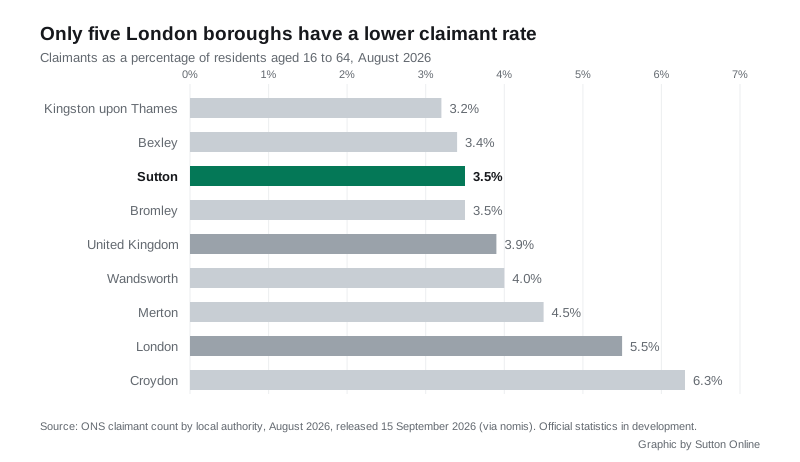
The gap with the borough next door is the number worth holding on to. Croydon’s rate is 6.3 per cent, nearly double Sutton’s. Merton is on 4.5 per cent and Wandsworth on 4.0 per cent. Kingston upon Thames, on 3.2 per cent, is the only neighbouring borough doing better.
At the top of the London table are Newham, Haringey and Barking and Dagenham, all on 7.4 per cent. At the bottom are the City of London on 1.1 per cent and Richmond upon Thames on 2.6 per cent.
Who the 4,755 are
The ONS breaks the borough figure down by age and by sex:
- aged 16 to 24: 760
- aged 25 to 49: 2,800
- aged 50 and over: 1,195
- men: 2,445, women: 2,305
The 25 to 49 group accounts for nearly six in every ten claimants in the borough.
Two years of almost no movement
August’s rise looks less dramatic set against the record. Over the last 24 months Sutton’s claimant count has moved between 4,500 in November 2025 and 4,880 in June 2025, a range of 380 people either side of a flat line. The rate has sat between 3.3 and 3.6 per cent in every single one of those months.
August 2025 recorded 4,650 claimants. So the borough is 105 higher than a year ago, a rise of 2.3 per cent. On this measure Sutton’s labour market has barely moved since autumn 2024.
What the claimant count is, and what it is not
This is not the unemployment rate, and treating it as one is the most common mistake made with the figure.
The claimant count records people claiming benefits principally for the reason of being unemployed. Since Universal Credit replaced Jobseeker’s Allowance for most claimants, the count also includes people who are in work but on low earnings and still required to look for more. It therefore runs higher than the old JSA measure and does not map onto the ONS unemployment rate, which is built from a survey.
The ONS classes these local authority figures as official statistics in development, its label for statistics still being tested and improved. The next monthly release, covering September, is due on 20 October 2026.
What it means for you
If you are out of work in the borough, the practical routes are unchanged. Universal Credit claims are made through GOV.UK, and the council’s own advice pages cover benefits and money support.
If you are reading the figure as a measure of the local economy, the honest summary is stability rather than improvement. The borough is doing comparatively well within London, but it is doing about as well as it was two years ago, and the August increase of 130 is the largest single-month rise since February.
The same caution applies to the figures a council or a candidate may quote at you. A claim that unemployment in Sutton is 3.5 per cent is using the wrong word for the right number.
Sources
- ONS: claimant count by unitary and local authority, released 15 September 2026, next release 20 October 2026
- nomis: claimant count dataset NM_162_1, for the Sutton borough series, the age and sex breakdown and the London borough comparison
Our other Sutton data pages cover house prices, council tax bands and planning applications.
Have your say